The Parish You Hate, Hates You
The Path to New Plaques
South of Minneapolis the Great Plains begin. One of our members once worked for a construction company there. The owner was a devout Catholic who had built a business repointing the mortar on old church buildings. The business thrived because the Plains are dotted with such churches: built, furnished, funded, founded, and shaped by Catholic Bohemian immigrants over one hundred and fifty years ago.
They are filled with memorials, intentional and otherwise, of the fact that these buildings were built and peopled by men and women who felt that this parish was the heart of their community, and that they had a meaningful kind of ownership in it.
Throughout the American Midwest, and every other part of America where Catholicism has roots and a history, churches are littered with physical evidence that reminds us of a time when parishioners were actively involved in shaping the parish. Not just the church ladies: the whole community shaped the parish into what it was.
There are plaques saying that this shrine to this saint with this statue was built by this patron in 1958. Photos of a Marian surplice bought for this priest by this patron in 1962. This organization (perhaps a choir or a sodality) founded by this layman in such and such a year. This replica of Brugel’s Mystic Lamb was paid for by one man sixty years ago, this organ bought for the parish by another a decade earlier. So on and so forth.
The plaques remain, the pictures remain, and the memory remains of a time when every parish was a home. The laity had put their livelihoods into beautifying their parishes. It was theirs.
To be at one of these parishes is to feel it palpably. It electrifies one, makes one feel pride in it even without knowing these names or recognizing these families. It makes one feel that this is soil worth building on, a place worth fighting for. If the parish has problems, you should stand your ground and fix them. You, like those who came before you, can fight the good fight, and change the parish into what it needs to be.
A few days ago, Patrick Neve published a Substack called “The Parish You Hate Might Need You,” calling on Catholics today to embrace this attitude. “Church hopping,” he says in the opening lines, “is killing our parishes.”
Contemporary Catholics tend to pick and choose among the parishes within driving distance, and for all but the most rural of Catholics, there are always at least four or five such options. And if the parish they currently attend becomes unacceptable, they leave and find a new one. Pat argues that this has had a acorrosive effect on the American Church. In his own words, “when faithful Catholics scatter across a diocese chasing the perfect parish, nobody builds anything.”
The article struck a chord among Catholics: Whether the reactions were positive or negative, they were strong. This is because they were reacting to more than a Substack article, or a “Comedian with a masters in Systematic Theology,” as Pat’s bio announces. Ultimately, the Substack had weight, and provoked such deep-rooted responses, because behind it lies a history, and a tradition (at least with a Lowercase T): a memory of times past which gives us a feeling that things ought to be that way still.
The reaction to Pat’s article, both for and against, was a reaction to a mode of Christian communal life which has mostly vanished but has left its relics to remind us of its beauty. It’s all around us, in the plaques below the stained-glass windows, on the doors to confessionals and the sides of pews, beneath the statues. There really was a time when standing your ground and investing your time and money in the parish in front of you (rather than seeking a more ideal one) could bear fruit.
It’s not a stupid conviction, this sense that we should put forth our hands to build up the parish in front of us, rather than roaming around in hopes of finding the parish we want already built for us. Any Catholic who can’t feel the pull of such a call has half a heart, or no eyes.
But it’s wrong.
A call for Catholics in 2026 to approach their parishes the way a Catholic could fifty, a hundred, a hundred fifty years ago is dangerously misguided, and the very beauty of the call only makes it a more enchanting siren song.
There was a time when the old way could work, and so long as it worked, it was a good and right thing to do.
We don’t live in that time anymore.
Time Travel
In a way, reading Pat’s article was like traveling back in time for many of us. Most of the membership of Christendom Quarterly have stories in which we directly attempted the strategy of parochial renewal, and we targeted our local parishes, with the same fervor we saw in the plaques, those memorials to the generosity and pride of the past.
We were parish business managers, youth group directors, campus ministers, religion teachers, young adult organizers, RCIA directors and teachers. We joined the parish councils, business councils, choirs, fish fry volunteers. We led bible studies, trained altar servers and cantors, organized and led retreats. We embedded ourselves in our local parishes, Catholic schools, and diocesan ministries.
Most of our members are late Gen X, Millennials, and early Gen Z. We deliberately armed ourselves as St. John Paul II’s army of Catholic Renewal. We came in on fire to serve, to be helpful, to bring our energy and devotion to God and place it at the service of the local Church, for the salvation of souls, for the blossoming of the Church.
That was especially the story of the many Millennials who seemed to have been educated and brought up for that very purpose — we were far from unique. There was a veritable army of us, and we spread throughout the American church, ready to bring a new fire. Remember Amazing Parish? Divine Renovation? 4 Marks of an Intentional Disciple? Rebuilt?
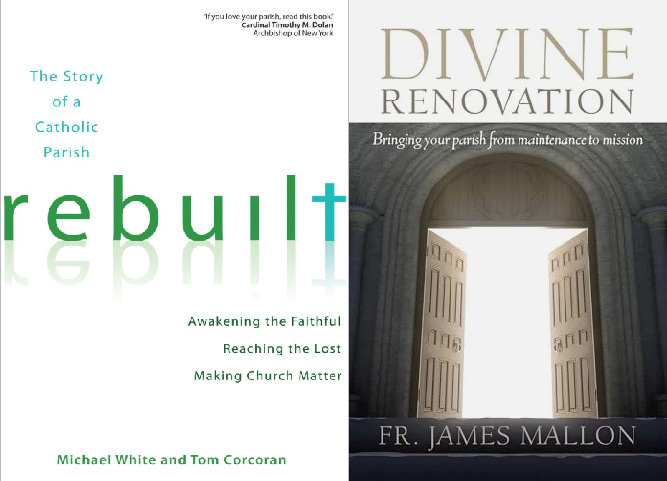
We bought copies of these books for pastors, coworkers, and volunteers. We organized study groups around these books and the topic in general. Pat’s arguments are not new, original, or timely — he is in fact making a lesser version of a repeated argument that has been well-developed inside of Catholic, Inc.
Most of the young laity bought in to this idea completely and embraced our roles as the vanguard of renewal. We thought we were the needed backup, that the Church had just been holding the line, waiting for relief, waiting for reinforcements.
We were wrong.
Anyone who has been working in the American Catholic church for any amount of time knows what happens. Let us outline some recent history of what happened to us during our times of zealous activity committing to a parish for revival.
Testimony from the Trenches
Each of the following are personal testimonies from our members. You will see in them two repeated themes:
(1) massive quantitative and qualitative success and accelerating momentum
(2) met by complaints, resistance, power struggles, and removal of the men accomplishing the momentum.
Repeated across the country, different roles, under different pastors and bishops, yet with a remarkable consistency that we all now recognize.
The first was a business manager of a local parish in the Midwest:
“I’m a fairly institutional-oriented person and I prefer to build within a structure in an orderly way. I became the business manager of a parish (ironically, we were an official participant in the Amazing Parish initiative). I began a Lectio Divina Bible study for young parents, but after the first meeting I was told I would have to stop. My masters degree was in history, not theology, and I wasn’t using a Diocesan approved curriculum. Never mind that I had led and participated in Bible Studies throughout my time at a Cardinal Newman university.
I saw many pointless power struggles, completely contrary to the spirit of Amazing Parish or simple goodwill. On example: at the behest of the DRE’s wife, the pastor banned a mother’s group from meeting. The DRE’s wife couldn’t bear to see any ministry succeed unless it was directly under her control, and neither the DRE nor the pastor would stand up to her.
The priest often spoke of the importance of discerning a call to the priesthood. He put up vocations posters and prayed for vocations often. He spoke of the importance of altar service as a form of vocational discernment. But the 68-year-old never-married woman in charge of the altar servers was domineering, mean spirited, and seemed to dislike boys. “You are always disrespectful,” “sit down on your hands if you can’t stop fidgeting,” were the kinds of comments she would often make towards my children. When my boys quit altar serving, I brought the problem to Father and offered to take on the altar boy training myself. This was met with hostility by Father, who suggested that my concern was driven by sexism, that it was good for the children to be exposed to multiple types of authority figures.”
Another of our number from the Northeast became a campus minister and youth group director. He testified:
“I became the campus minister and religion teacher of a Catholic High School. One of my first initiatives was launching a bible study. It became popular very quickly, due to the frank discourse and the commitment to church teaching on issues that were relevant to the youth. After one discussion that was not particularly controversial, a female student who was a guest of a weekly attendee seemed rather put off. The next week I was called into the school principal’s office. I was told by the principal that “the Bible study doesn’t seem to be going well and would need to stop.” I later found out that the guest of this teen had complained to her parents about being uncomfortable with the conversation, and these two parents complained very loudly to the principal, thus leading to the meeting.
During my first year, I immediately teamed up with the young school chaplain and religion teachers and together we established discipleship groups, involving the school faculty and parents as mentors. From nothing, we grew to dozens and dozens of mentees. We took those mentees and established yearly Chi Rho retreats, where the students themselves were the primary evangelists and leaders on the retreats. This again grew from nothing to hundreds of retreat participants per year, with at least half of the leadership coming from the kids themselves. We had Chi Rho reunions where previous retreat participants would get back together for games, fellowship, further leadership, and ongoing growth in Christ. We grew the choir by 50%, we increased men’s groups from nothing and weekly confession numbers skyrocketed.
But despite these regular successes, the chaplain and I were regularly on the receiving end of negative pressure and denied innumerable changes. We wanted all-male altar servers and were told no, and reliably no young men wanted to serve with the girls. We asked for the St. Michael prayer to be read after mass and were denied. Every liturgical suggestion was met with hostility – even though it was the chaplain saying mass and myself organizing all the lay participation, and we had universal success everywhere else.
By my 3rd year working, we took a record number of kids to the March for Life – almost double the previous years’ amounts. Upon returning from the March for life, I announced on the school morning radio show: “When you are older, what will you want to say to others: that you participated in the greatest civil rights challenge of your era, or that you waited it out on the sidelines? If you want to come next year, come see me, we will find a way for you to come.” I was later told by the principal: “You are ruffling feathers in an irresponsible way that is making parents upset by taking political stances. If you are going on the morning show, you will need to have what you are going to say cleared by me first.”
At some point, complaints came in that our chaplain was too traditional, too zealous. Despite all our mutual successes and his obvious devotion, he was removed and placed as chaplain to a hospital – presumably where he could do little harm. Attention on our retreats increased, attention on our men’s groups increased, and every complaint treated as deadly to the institution (even as our numbers increased). I was next on the chopping block and left for a parish.”
Another member became a youth group director in the Southeast. His testimony is below. Some details are changed for anonymity.
“I was hired by the parish part time to start. Despite this, I worked sixty hours a week to establish a ministry. I was on fire to get this parish growing and saw immense potential. When I joined, the youth group was no more than fifteen very socially awkward kids in the basement, with a few bullies who were taking advantage of the lack of intentionality to be domineering to their fellows. I started LifeTeen and various discipleship programs, a worship program, retreats, mission trips, adoration, and recruited a core team of volunteers who were willing to give at least 15 hours a week to mentoring.
Over the course of the next few years the group grew from 15 to over 300 high school youth in regular weekly attendance, and at least 1,000 monthly attendance of our bible study programs. What’s more, the gender split was 60% male to 40% female – unheard of in youth ministry; the Holy Grail. I came on as full-time, and although poorly paid, I felt tremendous pride and satisfaction for building what we had in so short a time. Kids were coming from nearby parishes and our program was starting to bear fruit not just in our parish but in those nearby, as well. Network effects were starting to emerge.
However, this changed when a young mother was hired on as the new head of faith formation at the parish. She was a domineering, administrative- and safety- oriented woman, and she decided to file a “gross negligence” complaint when I let a high school boy wrestle his college student friend (now a core team leader) during a mission trip. She used this to negotiate my lay off, and hired a docile, administrative, and socially awkward college senior.
The youth group shrank back to 15 weekly attendees within two years.
After this, the head of faith formation who laid me off and oversaw the group’s destruction was promoted to a high level diocesan role, and then to head of a large department at the USCCB.”
A member who served on a parish finance/business council in the Midwest writes:
“Our parish had an exceptional youth minister who made $29,000. It’s rare to have a male youth minister who is married with 2 kids, but because the stats show that fathers seem to have the greatest bearing on whether or not children retain the faith, our Parish council thought it was a gift to have such a talented leader join the parish team. When he requested a 10 percent increase in salary after having his next child, I advocated for this as the chair of finances. We had a donor who specifically commented on how much better the youth ministry program was this year, who gave 20,000 after his daughter went on a transformative retreat. I also noted that the youth minister had a 10k windfall from his budget that year because of his stewardship of the budget. However, when I advocated for the raise, the pastor told me that we didn’t have the money. I left the conversation confused, because I was actively involved in overseeing the books.
Three days later, in a business council meeting, the priest proposed a $37,000 dollar new tabernacle because he didn’t like the existing tabernacle, which was canonical and still fairly new. This purchase was approved, though I voted against it. Most of the finance council resigned that year, along with the youth minister. The youth program also died on the vine, and is now run more as an afterschool program with only five weekly attendees. For context, this is a parish of at least five thousand families.”
These are not isolated or unique
examples. They are perfectly representative of the majority of experiences amongst multiple generations. None of these stories will sound strange to longtime Catholics, especially graduates of Cardinal Newman schools, new converts, and anyone who has spent any time in a volunteer role in Catholic parochial life. These examples are the norm.
The Lost Decades
Some Catholics may think the church operates the way it does because leaders don’t know any better, or are overwhelmed, or there’s not enough money, or that there is some failure in creativity or energy. That’s why Pat and others write these kinds of articles. They think, “If only the well-intentioned laity, the good Catholic families, would stop and really commit, all these dying parishes could turn around overnight!”
They think that there is something missing. And in a sense, Pat is correct. We and many others have proved, numerically and qualitatively, that a dying parish and dying diocese can be turned around, that it only takes 1 to 3 years to increase participation, by literally 1,000%!
It’s not hard. The plans have been written and followed. The success has been proven, repeatedly, across the country, across decades. And it’s not ideological or liturgical. From Latin Mass parishes to charismatic parishes, across the spectrum, all have both seen incredible growth — for a time.
Until the growth is killed, deliberately stifled, snuffed out.
We know what is possible. Most of us have seen it, participated in it. In fact, we have many stories of young priests leading the charge and having similar results — massive parish-wide revival, conversions, whole families from grandparents to grandchildren rejoining the Church at once.
Amazing stories that mimic the Acts of the Apostles and reveal the Holy Spirit clearly at work. Then those priests are reassigned, to hospitals, to administrative work, to rotating distant parishes. This is the great confusion of the last 4 decades amongst the laity — lost decades, in many ways.
When confusion reigns in this way – when the salvation of souls is seemingly discouraged at every turn – it is useful to imagine what an outsider would think of the average American Catholic parish. If a non-interested stranger were to encounter the kind of resistance we have described, what would they think? One need only observe the behavior inside of parishes and dioceses, and apply the deepest logical reality there is: the purpose of something is what it does.
If you have never heard that phrase before, it has a long lore in the political sphere, where it is used to analyze the reality of systems above and beyond what politicians say about them.
If a politician says that Minnesotan children are in dire need of help and therefore our tax dollars must be deployed for the future of the state, well, that seems a noble goal. If one then merely observes the system at work, and follows the money trail from the taxpayer, to Minnesotan state coffers, to Somali daycare owners, to the airport, and finally to the dollar’s destination in Somalia, one accurately concludes that the true purpose of the tax system in Minnesota is to transfer money from taxpayers to various Somali tribes. The purpose of the system is revealed in the voting patterns of the Somalis, who vote in a single block for – surprise! – the exact politicians who vote to keep these monies flowing, and to increase them in new depths of corruption.
There is an inherent and understandable fear of applying the same thinking to the parochial and diocesan system. There is a terrible fear of discovering that, far from the parish being in dire need of rescuers and desperate for help in an inevitable reform, the parish is in fact functioning exactly as intended.
It is worth asking the most dangerous question of all: what if some of these leaders, some of these priests and bishops don’t want renewal? What if their incentives lead them to actively oppose the kind of revitalization that Pat is proposing, but which in fact several generations of Catholics have been attempting for the last 4 decades?
"What if the parish you hate, hates you?”
The Purpose of Something Is What It Does
Let us apply this logic, then, and articulate exactly what the system is meant to do. You need only examine the incentive structure for priests to understand this.
Is a priest rewarded for performance? Is he punished for incompetence? No.
The priest is rewarded for ensuring the fewest donor complaints are made to the bishop. He is rewarded for avoiding lawsuits. He is rewarded for not losing money, though closing parishes and selling off their assets at the diocesan level is tolerated if the PR can be carefully controlled.
The bishop’s job – and thus, his priest’s job – is to keep collections stable, even if in a downward trend with no end in sight. The U.S. consistently leads global Catholic donations, often contributing 28% to 30% of the Church’s worldwide revenue. It is the pastor’s job to keep that money flowing. He is not rewarded for fidelity to the faith. He is not promoted because Confession numbers or Mass attendance went up. In fact, if he preaches about Confession and someone sends an offended email to the bishop, he’ll get his hand slapped.
Just look at who gets promoted:
Cardinal Theodore McCarrick rose to become one of the most powerful men in the American Church. He led episcopal appointments, was a globe-trotting fundraiser, and a confidant of popes. All while credible warnings about his abuse of seminarians and manipulation of power were quietly ignored for decades.
Cardinal Bernard Law resigned in disgrace after the Boston Globe revealed his role in covering up predator priests, only to be appointed to a prestigious post in Rome.
Cardinal Donald Wuerl was named prominently in the Pennsylvania grand jury report for handling abuse allegations internally during his time in Pittsburgh and only resigned after sustained public outcry (we wrote about him specifically here).
Cardinal McElroy, despite facing credible public accusations of ignoring warnings about abuse, was elevated by Pope Francis to the College of Cardinals.
A Bishop can write an erotic book entitled “Heal Me With Your Mouth” and be promoted to Archbishop, then Cardinal, then Secretariat of the Dicastery of the Doctrine of the Faith, and be the Pope’s ghostwriter, as Cardinal Tucho Fernandez’s career shows.
This is not an accident. It is a pattern. Men who protect the institutions rise, even as the institutions degrade further each year. Men who rock the boat, by speaking plainly, acting boldly, or upholding the faith with clarity, do not.
Just look at Bishop Strickland. That’s how the game is played.
And what about parish staff and volunteers? Their job is to support the mission of managed decline. Susan from the Parish Council is a meme for a very good reason.
The councils, the committees, the little fiefdoms of the men’s and women’s clubs, they exist not to grow, but to act as bulwarks against change. Even if the Pastor wants change, he has to deal with this interconnected web of laypeople who have his bishop’s office on speed dial and know exactly what to say for the pastor to get an unwanted call himself. “Uncharitable. Pushy. Demanding. Rigid.”
Pastors, then, have become powerless middle managers. They own 0 assets, are completely and utterly dependent on the whims of diocesan politics to survive and are under the thumb of the loudest complainers in the parish.
Those brave pastors who buck this trend are run over. In one of our local parishes, the priest was removed because he did not use the Extraordinary Ministers of Holy Communion sufficiently, and this labeled him as too much of a traditionalist.
This is the reality.
Parishes and whole dioceses are going bankrupt. American Bishops are far more committed to collegiality and mutual support than they are to reversing the trend in their own diocese, thus making others look bad.
Bishops would rather close 30% of the parishes in their diocese than take the risks necessary to change. Until this incentive structure changes, dioceses declare bankruptcy, and American Catholics have been fleeced of every dollar that can be taken from them, there is no saving Catholic parishes through the volunteering effort of the laity.
This dysfunctional dynamic is not overcome by simpleminded goodwill.
Over the next twenty years, parish closures and consolidations are likely to accelerate, not slow. The U.S. fertility rate is now around 1.6 births per woman, far below replacement, meaning fewer baptisms, fewer young families, and fewer future donors. Even if Catholic identity levels off, practice and giving can still continue to erode, especially among younger cohorts.
Meanwhile, inflation and cost pressures hit parishes brutally: buildings and insurance don’t get cheaper, and diocesan reports explicitly warn that offertory must rise just to keep up with inflation and expenses. Put together, the most realistic forecast is substantial. Some estimates project a reduction of 30% of parishes through closures or mergers. This means thousands of individual parish communities dissolved or consolidated into administrative “parish groupings” where a single priest serves what once was 3 or more former parishes, as in Detroit amongst many others.
The Path to New Plaques
The Church is 2,000 years old. The Faith of our Fathers has weathered far more than this crisis.
There is a path.
This systematic choice of managed parochial and diocesan decline is a fight amongst and within the priesthood and episcopacy. Christ himself and his anointed priests must and will deal with that problem from within. Perhaps our children will have vocations and become new Elijahs. But we, the laity, must trust the Lord to have his way with the hierarchy, to protect the deposit of faith, and to provide for us.
The path of the laity is not for us to push back into the parishes. It is not for us to rush again into a battleground in which we are powerless, unwanted, and ineffective.
Our path lies entirely outside the parish, in our homes and in society. In a way, Pat acknowledged this in his follow-up, attempting to deflect the naivete of his original post by saying: “Any Catholic can meet with other Catholics at their house to pray, learn, and grow in faith. With the Holy Spirit, that initiative can grow to something parish-wide.” Indeed, that is the only way laypeople will build: outside the parish structure, outside diocesan control.
The path of the laity is in building American Christendom.
Christendom is the application of the Catholic faith at scale in the nation. This is, for many Catholics, a strange and perhaps even alien concept. We are so used to being in a state of navel-gazing as our parishes collapse around us that it is perhaps difficult to imagine this as the beginning of true Christian political revival, of the re-enshrinement of Christ the King as the political North Star.
And yet, it is happening almost organically. Catholics dominate the Supreme Court. We have a Catholic Vice President. Catholics are prominent across the political spectrum, and “Christ is King” resounds as a clarion call across the political right.
Building Christendom in America - and worldwide - requires precisely nothing from the Church hierarchy. Absolutely nothing. Putting God’s will for our nation into action today requires nothing from your local bishop, nothing from the Vatican, nothing from the Pope.
Only the laity can build Christendom. The hierarchy has nothing to do with it. They cannot run for office. They cannot support your run. They cannot fund you. They cannot speak for you. They are as powerless in the realm of nation-building as the laity is in effecting change inside the hierarchy.
Building American Christendom is accomplished primarily by placing Catholics, Christians, and virtuous men in positions of authority and power. You need nothing from the Church hierarchy to build on the momentum the current administration has started and to participate in the spiritual, intellectual, and economic revival in this country.
You do not need clerical support to have more children than you can afford. You do not need their affirmation to buy and train with a weapon and serve as a shield for your society. You do not need their approval to master your craft, earn enough for almsgiving that transforms your local community, or found a new Knights Templar. You do not need their permission to build a community of Catholics that takes over local politics—installing the sheriff, DA, and judges who will enforce order. You do not need their direction to mentor and disciple young people in your area and raise the next generation for success.
So, we here at Christendom Quarterly advise you to do precisely the opposite of joining that parish you hate and attempting to revive it from within.
Stop pretending the clerical realm is our realm, or ours theirs. Begin the spiritual practice of distancing yourself from their world. Drive to the best parish—the one with the highest impact on your family and children. Find powerful laymen there. Make them more powerful. Support their businesses. Promote your own. Hire the young, pay them well, bring the youth up in new power structures with Catholic faith at its center.
Build up and control the purse. Build up and control what is socially acceptable. Build up and direct an army of men and families to support new initiatives with social and economic capital so vast that the local priests and bishops will have no choice but to embrace growth mindsets.
In the short term, laymen must abandon all desires, plans, and schemes to force change on the hierarchy and on the local parish. Abandon them completely. Stop pretending that they are merely waiting for our help, are clueless, or simply need a little encouragement.
When it comes to the internal decision-making of the Church—from the Vatican down to the parish council—we are completely powerless. We must give up any attempted manipulation. Our plans, stratagems, and efforts over decades have yielded nothing. It is insane to continue in this manner.
Begin the spiritual practice of building Christendom within your own vocation as a laymen, by asking God each day:
“Lord, you have placed me in this place at this time and given me the vocation of a layman. Show me how I can serve my family, master my craft, earn well. Show me how I can use those earnings and my time to build up your Kingdom in this town. Show me which friend to encourage to run for office. Give me the words to build up the young around me. And please, Lord, give us holy priests and bishops, because only you can do that. Amen.”
This conclusion reframes the earlier evidence of systemic inertia not as defeat but as liberation: the laity’s true sphere is outward, in family, work, community, and civic life. The parish remains a place for sacraments and worship—choose the healthiest one available—but the work of renewal and Christendom-building belongs to the baptized faithful in the world.
By following this path, Christ will be crowned King in our hearts, our families, our nations… and inevitably, back in our parishes.
And new memorials, with new plaques, will bear our names, as a witness to future generations.
Ad Majorem Dei Gloriam.


No comments:
Post a Comment
Please be respectful and courteous to others on this blog. We reserve the right to delete comments that violate courtesy and/or those that promote dissent from the Magisterium of the Roman Catholic Church.